

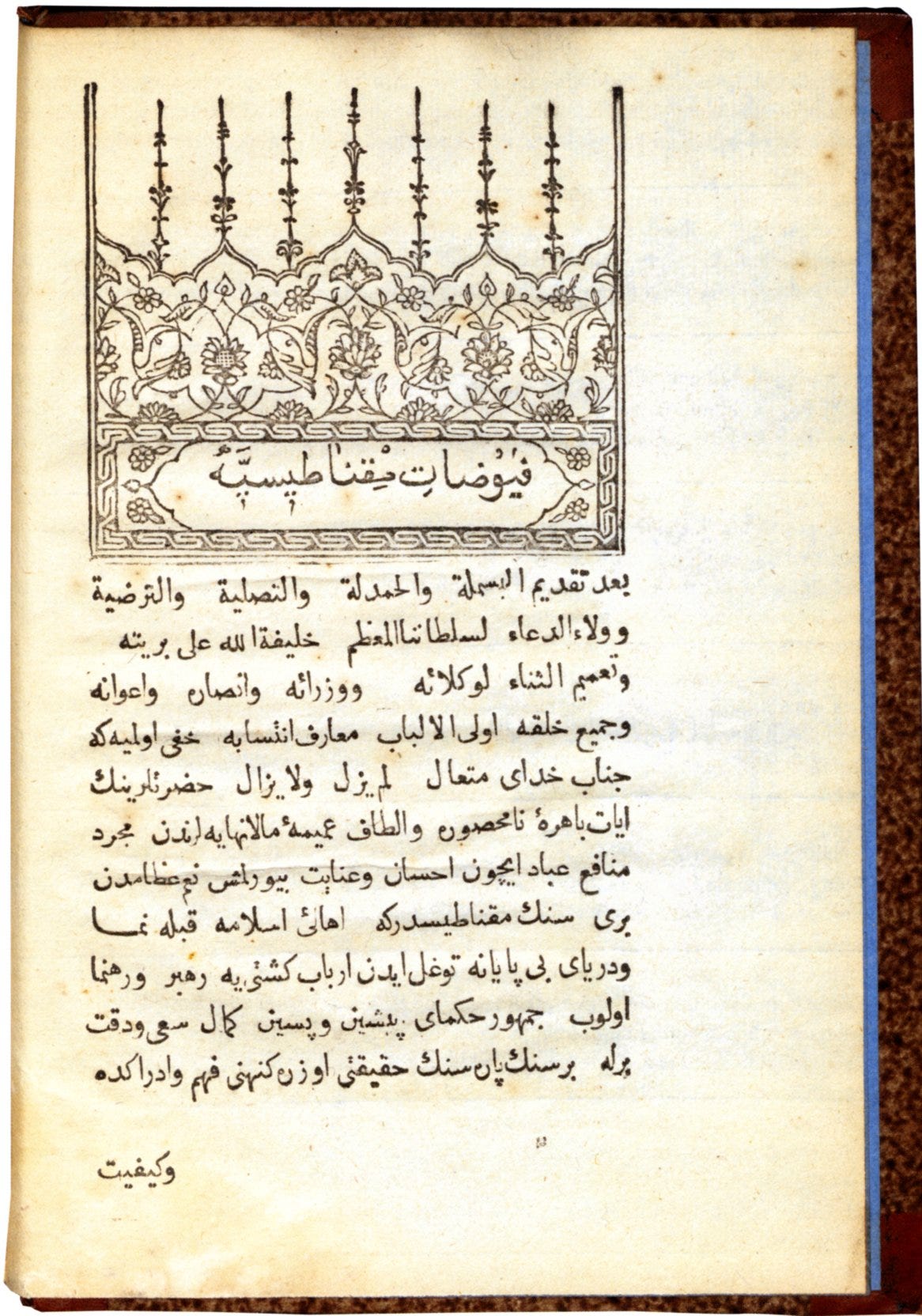
The decree is probably apocryphal. For four hundred years, historians have repeated that Sultan Bayezid II forbade printing in Arabic script on penalty of death, in 1485. The date is wrong. The firman has never been found. The source is a single French traveler, André Thevet, writing a century after the fact, who had been to the Levant briefly and was not expert in its languages. We have built a story about the Ottoman monopoly on the word out of one sentence from 1584.
What is not apocryphal is the outcome. From Gutenberg’s press in Mainz until İbrahim Müteferrika opened the first Arabic-script press in Istanbul in 1727, the empire that stretched from the Danube to the Red Sea did not print in the language of its prayer books, its law, or its commerce. Two hundred and forty-two years. Europe printed. The Ottomans did not. In the space between those two choices, the history we now read as inevitable was made.
Historians do not trust their sources. They interrogate them. They ask who wrote this, and when, and for whom. They ask what the writer could not say, or would not say, or did not know. They look for the missing letter, the burned ledger, the census that never counted the ones who did not want to be counted. They weigh a traveler’s account against a local’s, and both against the silence of those who left no account at all. The work is slow and unglamorous and produces conclusions hedged with qualifiers. It is the only work that has ever produced anything worth calling history.
This is the habit of mind historiography teaches. The field has a more elegant name for it — source criticism — but the practice is simpler than the term. Assume every record is made. Ask by whom. Ask why. Ask what was omitted.
The habit was once confined to the past. The past was where the evidence was rationed, where the archives were thin, where the researcher had to do the careful work because there was no other way. The present ran on wire copy and cable traffic and the morning paper — sources treated with less suspicion because there was less time and less access to do otherwise. You trusted the Reuters lead because the alternative was to not know.
That condition no longer applies. The present is now as source-rich as the past used to be sparse. The ledgers are searchable. The ships transmit their positions. The aircraft announce themselves on public feeds. The ministerial calendars leak. The court filings translate in seconds into languages the filer never intended to publish in. And the traveler’s account — the Thevet, the suspect narrator — is now every actor who speaks on every platform about every event.
The question historians ask of the dead is now available to ask of the living.
GDELT — the Global Database of Events, Language, and Tone — updates every fifteen minutes, in a hundred languages, and has been doing so since 1979. A single year now runs two and a half terabytes. No intelligence service built this. A researcher named Kalev Leetaru did, and it runs on public feeds any citizen can query. That is one catalog. There are also the ship transponders, the flight tracks, the court dockets, the import ledgers, the satellite passes, and the telemetry of capital.
In 2018, the British government identified the two GRU officers who poisoned Sergei and Yulia Skripal in Salisbury. That attribution, delivered through an SIS apparatus built over a century, named faces and aliases. Within weeks, a small team of journalists working with flight records, passport leaks, and social media traces — Bellingcat’s Salisbury Poisoning investigation, joined by The Insider and Der Spiegel — named the men by their real names, their unit (29155), their military academy, and the vehicle they had used. The open-source reconstruction went further than the state’s.
By the winter of 2022, the same pattern ran at scale. For three months before Russian forces crossed into Ukraine, civilians in Belarus and southern Russia were filming convoys for TikTok. Commercial satellite imagery showed field hospitals being staged. A community of analysts — academics, veterans, hobbyists — read the signs and called the invasion in writing, by date range, before most Western governments made their own assessments public. The data was not classified — it was observed by the people living next to it and broadcast to the world through the phones in their hands.
This is the inflection. The distance between what is happening and who can see it has collapsed.
The question the press could not answer was what to do with what had been printed. Gutenberg gave Europe the Bible in German, the sermon in the vernacular, the pamphlet in the market square. He did not give it the reader. That arrived later, unevenly, through catechism and schoolhouse and argument — and it arrived incompletely. What Gutenberg could not do was teach anyone to read what they could now read.
The same gap opens now, wider.
A flight-tracking dataset is not an assessment. A satellite image is not a judgment. A leaked spreadsheet is not a conclusion. The work that turns any of these into a finding has a name — source grading, calibrated confidence, competing hypotheses, explicit assumptions — and it used to live inside buildings with doors and clearances and people paid to apply it. Those buildings still exist. They are no longer the only rooms where the work gets done.
The skills can be taught in an afternoon. Distinguish the source you trust from the source you find convenient. Assign a probability to a judgment and defend it when you are wrong. Argue the opposing case before reaching your own. Mark what would change the assessment. Name what you are assuming. These are the disciplines that separate intelligence from opinion, and they are the work the institutions used to do on behalf of everyone else.
Almost no one teaches them.
The bottleneck is no longer access. The bottleneck is the discipline to hold two hypotheses in mind before collapsing to one, to note the grade of the source next to the claim it supports, to mean the difference between probable and almost certain. Slow work. Unglamorous. Available to anyone who will do it.
That is what Gutenberg could not do.
Müteferrika’s press ran for seventeen years and then it closed. What we have now will not close. It is here and it keeps arriving and no one is in charge of reading it. That is the work.
The views expressed are the author’s personal views and do not represent the position of any employer or government.
References
Bellingcat. “Skripal Suspect Boshirov Identified as GRU Colonel Anatoliy Chepiga.” Bellingcat Investigations, 26 September 2018. https://www.bellingcat.com/news/uk-and-europe/2018/09/26/skripal-suspect-boshirov-identified-gru-colonel-anatoliy-chepiga/
Bellingcat, The Insider, and Der Spiegel. “Unit 29155: The GRU’s Elite Assassination Squad.” Joint investigation series, 2019–2020. https://www.bellingcat.com/tag/unit-29155/
GDELT Project. “The GDELT 2.0 Event Database: Data Format and Technical Documentation.” www.gdeltproject.org, accessed April 2026.
Higgins, Eliot. We Are Bellingcat: An Intelligence Agency for the People. London: Bloomsbury, 2021.
Institute for the Study of War. “Russia–Ukraine Warning Update” series, November 2021 – February 2022.
https://www.understandingwar.org/
Leetaru, Kalev, and Philip A. Schrodt. “GDELT: Global Data on Events, Location, and Tone, 1979–2012.” International Studies Association Annual Convention, San Francisco, 2013.
Lewis, Bernard. The Muslim Discovery of Europe. New York: W. W. Norton, 1982.
Pettegree, Andrew. Brand Luther: How an Unheralded Monk Turned His Small Town into a Center of Publishing, Made Himself the Most Famous Man in Europe — and Started the Protestant Reformation. New York: Penguin, 2015.
Sabev, Orlin. Waiting for Müteferrika: Glimpses of Ottoman Print Culture. Boston: Academic Studies Press, 2018.
Schwartz, Kathryn A. “Did Ottoman Sultans Ban Print?” Book History, vol. 20, 2017, pp. 1–39.
Thevet, André. La Cosmographie Universelle. Paris: Guillaume Chaudière, 1575. [Primary source of the Bayezid II decree claim; cited by later historians as the sole documentary basis for the alleged ban.]